

Start with your suppressor’s manual, because the right way to clean one depends on the model. As a rule, a sealed can gets filled with a suppressor-safe solvent and left to soak. A serviceable can comes apart and each part gets scrubbed. And the metal, aluminum, stainless steel or titanium, decides which solvents and tools are safe.
Many rifle suppressors almost never need a deep clean. A .22 suppressor does, and sooner than most people expect. This post covers how often, what to use on which metal, and what to leave alone. It is general information, so your maker’s instructions come first, and the sources are checked as of November 2026.
How to clean a suppressor: how often, and why
How often depends on what you shoot. Silencer Shop’s cleaning guide gives rough ranges:
- Centerfire rifle: rarely needs a deep clean. High-pressure gas clears most carbon, and many rifle suppressors run for tens of thousands of rounds without one.
- Pistol: a light cleaning every few thousand rounds, plus occasional service on the booster or piston if the can has one.
- Rimfire (.22): every 300 to 500 rounds. The fouling builds fast and does not clear itself.
Makers set their own schedules, and they differ. One maker’s published FAQ says to clean one of its .22 models every 500 rounds, and to clean the baffles of two of its pistol cans every 1,000 rounds. Its rifle suppressors need limited maintenance, it says, and the threads should be wiped after each range trip. Your manual, not a general rule, is the number to follow.
Rimfire fouling is not what most people think. According to the same Silencer Shop guide, it is mostly lead, not carbon. That is why a .22 can needs cleaning sooner than a rifle can.
Sealed or serviceable: two different jobs
Check whether your can can be taken apart. A sealed can, sometimes called welded or tubeless, cannot be opened. A serviceable can comes apart into a tube, end caps and a baffle stack or a one-piece core.
Sealed can. Silencer Shop’s guide says to fill the tube with a suppressor-specific solvent, cap one end and let it soak, which it says can run 24 hours, then rinse and dry it completely. Follow the solvent maker’s time and your can’s manual, because a harsh solvent or a long soak can damage some metals and finishes.
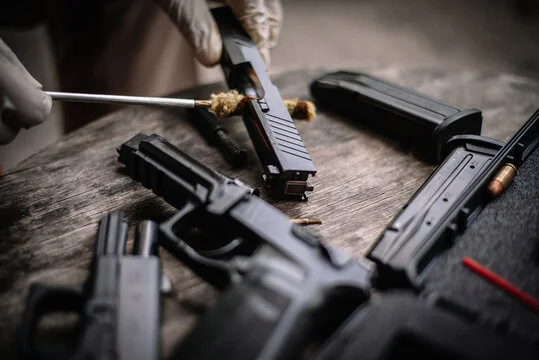
Serviceable can. Take it apart as the manual shows, and clean each part:
- Baffles or core. These trap most of the carbon and lead. Use a brush, and a plastic or brass pick for corners, depending on what your manual says. Silencer Shop says plastic. The Rugged FAQ calls for a brass pick on some models and a nylon brush on others.
- Tube and end caps. Usually a wipe-down.
- Threads. A few passes with a nylon brush and a little solvent.
- Pistons and boosters. Wipe them clean and add a thin film of lubricant if the manual says so. That maker’s FAQ says to lubricate the outside of the piston on its pistol cans before each range trip.
- O-rings. Wipe and lightly lube them, and take them out before any soak or ultrasonic cycle.
Wear gloves and eye protection, and wash your hands afterward. The residue on those parts is carbon, lead and solvent.
Aluminum, stainless or titanium: match the method to the metal
The metal matters more than the brand of cleaner. Silencer Shop’s guide lays out what each one can take:
| Metal | Solvents | Methods that work | Methods to avoid |
|---|---|---|---|
| Aluminum | Avoid harsh solvents, which can erode or pit it | Brush and solvent, or soda blasting | Ultrasonic cleaning, tumbling |
| Stainless steel | Most non-corrosive solvents, such as a standard gun cleaner | Most methods | Check any coating first, since coatings can be less durable than the metal |
| Titanium | Neutral-pH cleaners | Most methods | Acidic, chlorinated and ammonia-based solvents, which can pit the baffles |
The same guide says not to use an ultrasonic cleaner on aluminum or coated tubes, not to soda-blast anodized or Cerakoted parts, and not to tumble aluminum. A maker’s FAQ gives the same warning model by model: some of its models must not go in an ultrasonic at all, while the baffles of one .22 model can, using a 50/50 mix of a degreaser and water. The takeaway is that two cans from one maker can have different rules. Our titanium vs steel suppressor post explains why the metals behave so differently.
Silencer Shop also warns against one common method called “the dip.” It calls it hazardous to people and the environment and does not recommend it. We will not describe it here either. For a general gun cleaner and what each type does, see gun oil vs CLP.
Dry it and put it back together carefully
Reassembly is where people get hurt, so slow down.
- Make sure every part is completely dry. Silencer Shop says leftover solvent can cause “unexpected pressure events.” Let parts air-dry on a clean towel for at least 30 minutes, or use compressed air.
- Towel off any film left by an ultrasonic cycle.
- Keep mating surfaces clean. Trapped grit can throw the baffles out of alignment.
- Put it back in the original order and orientation. Then confirm it is fully tightened before you shoot.
- Do not grip the body with bare pliers. The finish will mark.
A wet suppressor is a different case, because the water or gel goes in on purpose. Our wet vs dry suppressor post covers how wet use works.
What not to do: leave the parts alone
Cleaning is not modifying. Do not drill, cut, swap or add parts to your suppressor. The law treats each part as significant. Under 18 U.S.C. 921, a “firearm silencer” includes any part intended only for use in building one. The National Firearms Act defines “make” to include “putting together” and “altering,” in 26 U.S.C. 5845.
Treat repair, rebuilding and caliber work as a job for the maker, not something to try on the bench. If a part is damaged, or you are not sure whether something is meant to come apart, ask the maker before you open it.
Where to go from here
A clean suppressor is mostly about reading the one page of instructions that came with it. If you are still choosing a can, ask how each one is cleaned before you buy, because a sealed rimfire can and a fully serviceable one are very different chores. We are happy to talk through it at the counter in Cumming. Read how buying one works on our suppressor page, or send us a question before you drive over. If you are cleaning the gun too, our post on how to clean a pistol covers that side.
Sources: Silencer Shop’s cleaning guide, one maker’s published FAQ, and 18 U.S.C. 921 and 26 U.S.C. 5845 (Cornell Legal Information Institute).


