

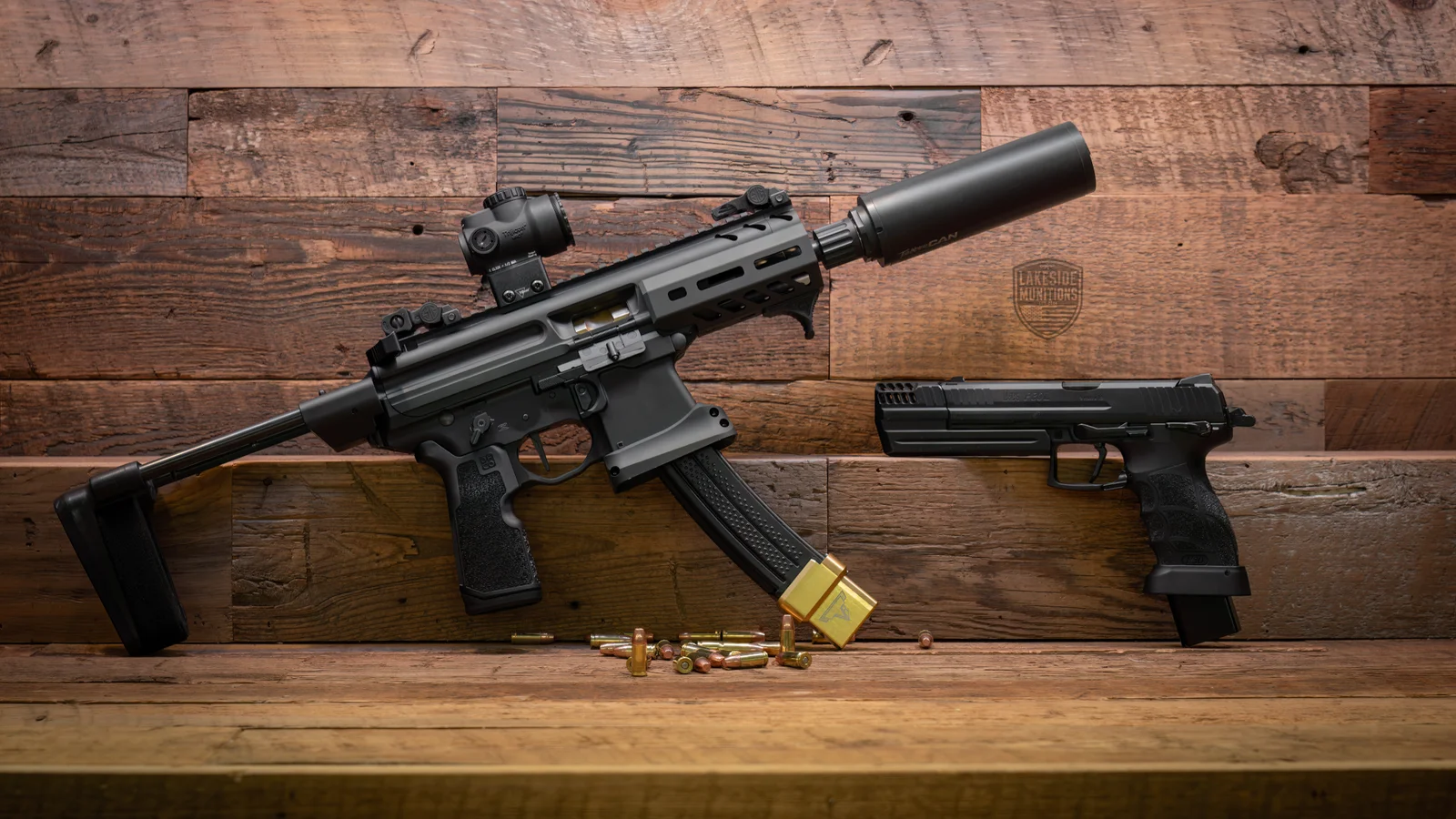
A pistol caliber carbine is a rifle-style gun that fires ammunition made for handguns, like 9 mm. People shorten the name to PCC. It gives you a stock to put against your shoulder and a longer barrel, but it uses the same kind of cartridge a pistol does.
That mix is the whole appeal, and it is also the whole trade. This post explains what a pistol caliber carbine adds over a pistol, what it gives up next to a rifle, and the barrel length rule that sets it apart under federal law. It does not pick a model. The right one depends on what you want it for.
What is a pistol caliber carbine?
Richard Mann, writing for NRA Shooting Illustrated, describes a pistol caliber carbine as a long gun that is easy to handle, has low recoil, and fires ammunition usually associated with handguns. Carbine is the word for a shorter, lighter rifle.
So a PCC sits between two kinds of gun. It handles like a small rifle, and it fires the cartridge you may already know from a pistol. It is not a pistol, and it is not a rifle in a rifle caliber like 5.56 NATO.
Mann’s article is from 2011. The numbers below are his, so treat them as a guide, not a test of any gun on a shelf today.
What does a carbine add over a pistol?
The biggest change is the barrel. A pistol barrel is short, and a carbine barrel is much longer, so the bullet has more time in the barrel and leaves faster.
Mann says a 16 inch carbine barrel adds about 230 feet per second over a 4 or 5 inch pistol barrel. That is roughly 20 feet per second for every inch of barrel, or about a 20 percent gain in impact speed.
His test on accuracy matched that. At 7 yards, shooters were about as fast and accurate with handguns as with carbines. At 25 yards, carbines were about 30 percent faster and 20 percent more accurate than handguns.
How much does it kick? Less than a rifle in a rifle caliber, according to Mann’s numbers. He says a 6.5 pound carbine in 5.56 NATO produces about 3.7 foot-pounds of recoil. A 9 mm carbine of the same weight produces less than half that. A .40 S&W carbine is about two thirds of it, and a .45 ACP carbine produces about 35 percent more than the 5.56.
The point is that caliber matters as much as the platform. A heavier handgun cartridge kicks more, even in a carbine. Mann also warns that a pistol caliber carbine is not necessarily easier to control than a rifle-caliber carbine. Do not assume it will be.
The 16 inch rule
This is the part many new buyers miss. Federal law treats a rifle with a barrel shorter than 16 inches as a special category.
The regulations define a short-barreled rifle as a rifle with one or more barrels less than 16 inches long, and any weapon made from a rifle that has an overall length of less than 26 inches (27 CFR 478.11). The National Firearms Act lists both in its definition of a firearm (26 U.S.C. 5845(a)). That puts them in the same federal category as suppressors, with their own approval process.
Mann puts it simply: a 16 inch barrel is the minimum legal length for a carbine, unless it is a registered short-barreled rifle. So when you shop, pay attention to barrel length and overall length. A gun that meets both numbers is an ordinary rifle. One that falls short is a different thing under federal law.
This is general information as of November 2026. It is not legal advice, and an attorney can answer questions about a specific gun. If you want to know how the NFA process works for a purchase, our suppressor page explains the steps, which are similar for any item in that category.
What a PCC gives up
A pistol cartridge gains speed in a carbine barrel, but the gains have limits.
Mann says at 75 and 100 yards, pistol caliber carbines were only half as accurate as a 5.56 NATO carbine. The bullet’s speed at just under 75 yards roughly matches a handgun’s speed at about 3 yards, and past 100 yards he says a PCC cannot compete with a 5.56 NATO carbine for trajectory, accuracy or wounding ability.
He also notes that accessories and spare magazines are less available for pistol caliber carbines than for rifle-caliber carbines. Before you buy, ask what magazines and parts the gun uses and whether you can get more later.
Does sharing ammunition with your pistol matter? It is one of the first selling points you will hear: one cartridge for a pistol and a carbine. Mann is lukewarm on it. He says sharing ammunition with a handgun is useful but not that big of a deal. It can simplify what you buy, but it should not be the only reason to choose a carbine.
Is a PCC a good first rifle?
It can be, if the fit is right. It has less kick than many rifle calibers and it handles easily. If your goal is learning to shoot a long gun, you might also read our post on the best first rifle, which looks at a different starting point.
Ask the counter a few plain questions before you buy: what magazines does it use, how long is the barrel, how long is the gun overall, and is it built as a rifle? If you plan to add a red dot, our gunsmithing page lists what mounting one costs, and our post on how to bore sight a rifle shows how to get a new optic on target.
Ask yourself what you want the gun to do. If it is range fun at short distances, a PCC makes sense. If you want to shoot past 100 yards, look at a rifle caliber instead.
Whatever you buy, the NSSF’s rules of firearms safety apply the same way: keep the muzzle pointed in a safe direction, keep it unloaded when you are not shooting, be sure of your target and what is beyond it, and use the right ammunition for your gun.
Come handle one
A pistol caliber carbine is a personal choice, and the best test is how it feels in your own hands. Lakeside Munitions will not tell you that a pistol caliber carbine is the right gun for you. We would rather you hold a few and decide. Come by the counter, tell us what you want it for, and ask to compare a carbine with a rifle. If you want one that is not on the shelf, ask about a special order. If you bought one online, an FFL transfer brings it through our counter. If you are new to all of this, read what happens when you buy your first gun in Georgia. Or send us a question first.

