

In the LPVO vs red dot choice, pick a red dot if most of your shots are inside 100 yards and you want a light, fast rifle. Pick an LPVO if you also want to reach farther and can live with more weight on the front of the gun. An LPVO, short for low power variable optic, is a scope that goes from 1x (no zoom) up to a modest zoom.
Neither is better for everyone. They solve different problems, and they cost you different things.
LPVO vs red dot: what an LPVO actually is
Vortex describes an LPVO as a “jack of all trades” optic. At 1x it works much like a red dot for close shots. Turn the dial and it magnifies to 4x, 6x, 8x or even 10x for longer shots (Vortex on LPVOs).
Common sizes are written 1-6x or 1-8x. The first number is the lowest zoom. The second is the highest. A 1-6x scope can show you a target at six times its normal size.
A red dot has no zoom at all. It gives you one lit dot and a clear view of the target with both eyes open. If you want to compare red dot designs first, read our post on red dot vs holographic sights.
Weight: the biggest trade-off
Here are real numbers from the makers. Vortex lists its Strike Eagle 1-6x24 at 18.5 ounces and 10.5 inches long (Vortex Strike Eagle 1-6x24). Aimpoint lists its Micro T-2 red dot at 3.3 ounces, sight only (Aimpoint product sheet). EOTech lists its EXPS3 holographic sight at 11.2 ounces (EOTech EXPS3).
| Optic | Type | Listed weight |
|---|---|---|
| Aimpoint Micro T-2 | Red dot, no zoom | 3.3 oz (sight only) |
| EOTech EXPS3 | Holographic, no zoom | 11.2 oz |
| Vortex Strike Eagle 1-6x24 | LPVO, 1-6x | 18.5 oz |
That LPVO is more than five times the weight of the red dot. These are single models, so other LPVOs and red dots will differ. The pattern holds, though: zoom adds weight.
Weight on the front of a rifle is easiest to feel when you hold it up for a while or move fast with it. If you walk with the rifle, shoot long strings or run drills, it adds up.
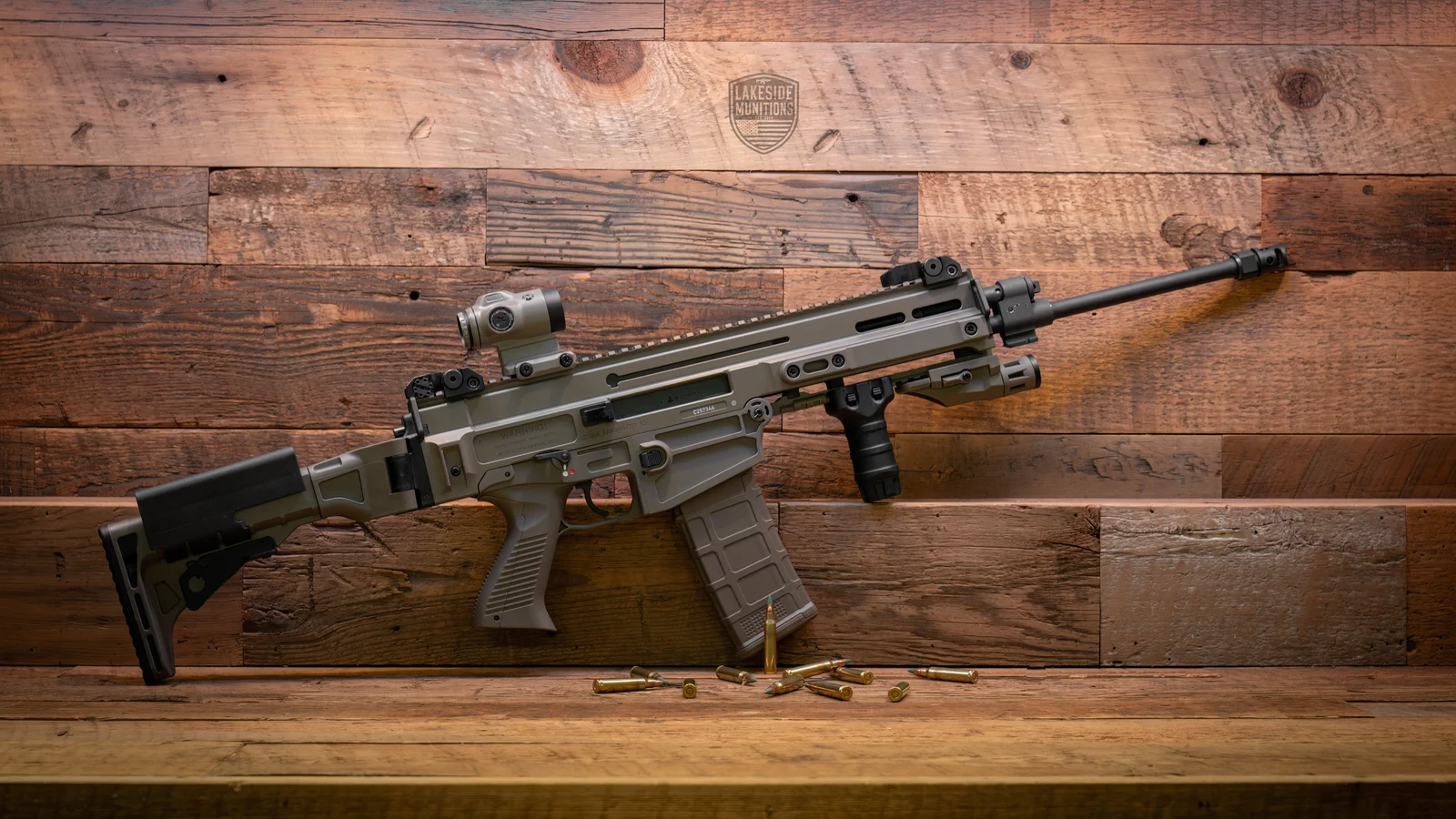
Speed and simplicity
Vortex says no riflescope will match a red dot’s “intuitive speed, simplicity, and lightweight-ness” (Vortex on LPVOs). A scope maker is telling you the red dot wins here.
It also says the gap at 1x keeps getting smaller as the technology improves. So an LPVO is not slow. A red dot is just quicker and simpler, which helps if you are new.
The Strike Eagle 1-6x24 lists 3.5 inches of eye relief. That is how far your eye should sit behind the glass to see the full picture. Aimpoint describes its red dot as parallax-free, which means the dot stays on target even if your eye is a little off center.
Field of view and distance
Field of view is how wide a scene you can see through the optic. Vortex lists the Strike Eagle 1-6x24 at 116.5 feet wide at 1x and 19.2 feet wide at 6x, both measured at 100 yards. That is a big drop.
At 1x you see a lot, which is why an LPVO can work for close shots. At 6x you see a narrow slice, but the target looks six times larger. That helps you see small targets at distance, and it helps you tell where your shots land.
If you rarely shoot past 100 yards, you will mostly use the 1x end of the scope. Then you are hauling the weight of the zoom and not using it. If you shoot out to 200 yards or more, the zoom starts to earn its place. That is our rule of thumb, not a number from a maker.
Quirks of a scope at 1x
An LPVO at 1x is not quite the same as a red dot. Vortex says the lowest power LPVOs start at a true 1x, but you must adjust the diopter, the focus ring on the eyepiece, so the image looks closest to what you see with your naked eye. It also says distortion is most noticeable at the outer edges of the image (Vortex on LPVOs).
None of that is a deal breaker. It does mean a scope takes a little more set up and a little more practice than a dot.
Reticles and aiming marks
Many LPVOs, including this Vortex, have a reticle with aiming marks for holdover. Holdover means aiming higher to account for bullet drop at distance. How well it works depends on the focal plane.
The Strike Eagle 1-6x24 is a second focal plane scope. Vortex says that in a second focal plane scope the reticle stays its normal size as you change the zoom, and the hash marks are only usable at the scope’s calibrated power, which is typically the highest (Vortex on focal planes).
So the marks only line up with the ground at one setting. If you plan to use them, read the manual for your exact scope. If you want a clean 1x aim with the zoom as a bonus, this matters less.
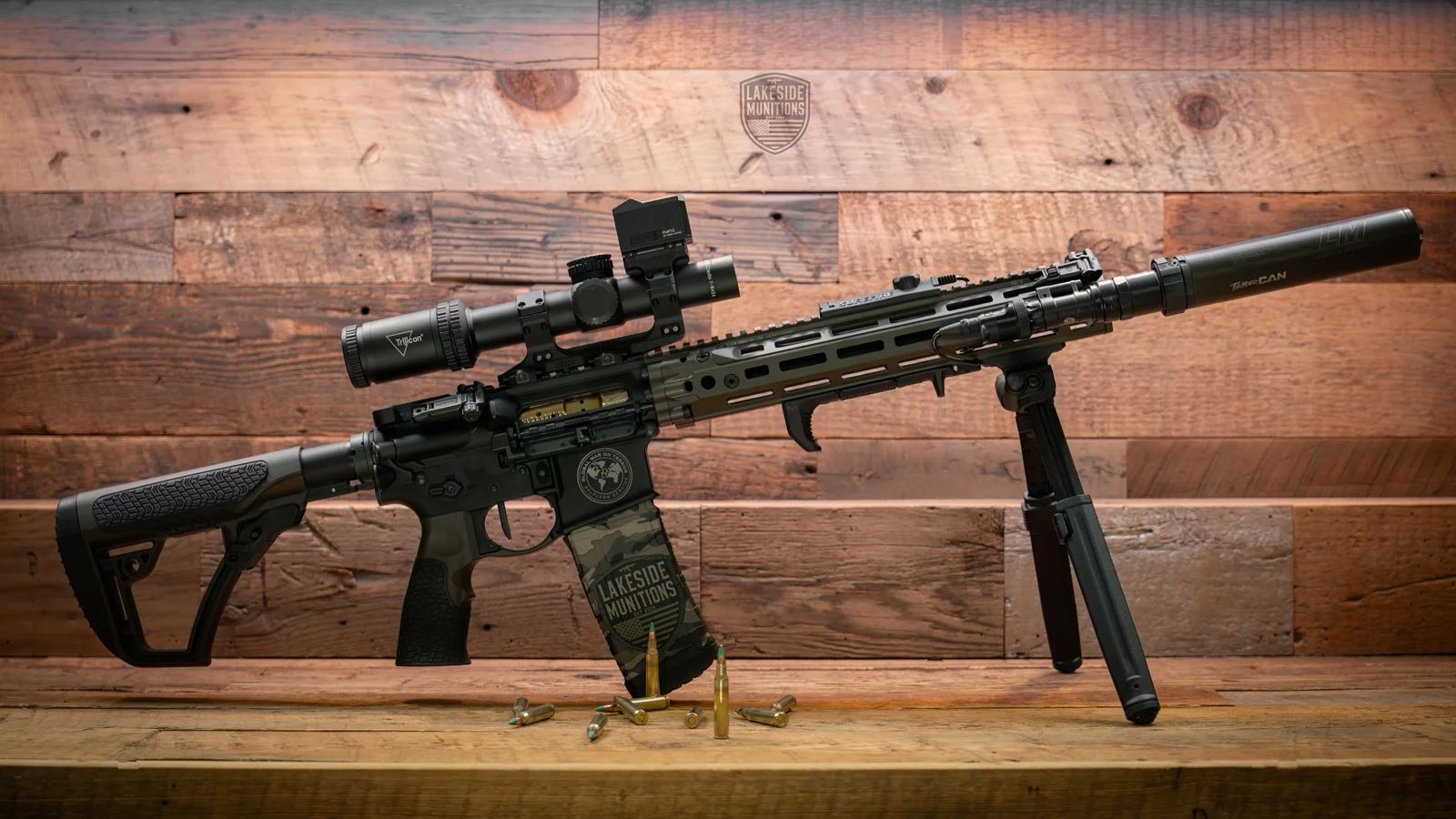
A third option: both
The photo above shows a rifle with a scope and a red dot together. Some shooters set up a rifle that way. It adds even more weight and more parts to mount, so it is not for everyone.
Another route is a red dot with a magnifier behind it. That adds zoom to a red dot, and it is a separate choice from an LPVO. EOTech, for example, sells 3x and 5x magnifiers with a switch-to-side design, made to pair with its holographic sights (EOTech EXPS3). The magnifier swings out of the way when you do not need it.
How to decide
Answer these three questions:
- How far is your longest normal shot? Under 100 yards points to a red dot. Beyond 200 yards points to an LPVO.
- How much does the weight bother you? If you shoot a long day or move a lot, lean toward the red dot.
- Is this your first rifle optic? A red dot is simpler to learn.
This is our advice, not a rule. If you are unsure, tell the counter what the rifle is for and where you shoot. They can show you both side by side.
Mounting matters as much as the optic
A scope needs the right rings or mount at the right height, and then it needs to be lined up with the rifle. Our post on how to bore sight a rifle shows how you get on paper before the range. Our post on scope ring height covers the mount side.
At Lakeside Munitions, an optic mount is $45, for a red dot or a magnified optic, and bore sighting is $15. If you buy the optic here, we install it for free. See every posted price on our gunsmithing page, or contact us with your rifle and the optic you are weighing.
Sources checked November 2026. Specs come from the makers and change by model, so check the exact one you plan to buy.


