

The lower receiver is the part of an AR-15 that federal regulation treats as the firearm. It is the lower half of the rifle, the part that houses the trigger mechanism and the hammer. Because the law counts it as the gun, a lower receiver is serialized and goes through a licensed dealer just like a complete rifle.
That surprises many first-time AR buyers. They expect to buy a “part” with no paperwork. This post explains why the lower is different, what the law says, and what it means at the counter. It is general information, not legal advice, and it is current as of November 2026.
What is an AR-15 lower receiver?
An AR-15 is built in two main halves, the upper and the lower. The lower is the half that holds the trigger mechanism and the hammer.
That description is not just a gun-shop habit. It is in ATF’s regulation. 27 CFR 478.12 defines the frame or receiver of a rifle as the part that houses the component that blocks the breech before firing. In a paragraph on earlier ATF classifications, it gives the AR-15 and M-16 as an example: the receiver “is the lower part of the weapon that provides housing for the trigger mechanism and hammer.”
The regulation also describes how to treat a frame or receiver that comes apart into multiple pieces. That section is about modular designs and is not something a buyer needs to work through. For an ordinary AR-15 style rifle, the lower is the receiver.
Why does the law treat the lower as the gun?
Because of how the federal law defines “firearm.” Under 18 U.S.C. 921(a)(3), a firearm includes a weapon that will or is designed to expel a projectile, and it also includes “the frame or receiver of any such weapon.” The regulation says the same thing: 27 CFR 478.11 defines a firearm to include the frame or receiver.
So the law does not wait until the rifle is put together. The frame or receiver by itself is a firearm. For an AR-15 that means the lower.
That is the whole reason for the rest of this post. A bare lower is a firearm in the eyes of the law, so the rules for firearms apply to it.
What does that mean for buying one?
If you buy a lower from a store, you buy it the way you would buy any gun. You show ID, fill out the federal form and, where it applies, pass the background check. A licensed dealer must record a sale of a firearm to someone who is not licensed on ATF Form 4473 (27 CFR 478.124). Because a lower is a firearm, the dealer identifies it on the form by its serial number, the same as a complete gun. We explain the form in our guide to Form 4473.
If you buy a lower online, it works like any other online gun. Federal law generally bars a licensee from shipping a firearm across state lines to someone who is not licensed (18 U.S.C. 922(a)), so it ships to a licensed dealer near you and you finish the transfer there. Our FFL transfers page covers the steps. At Lakeside Munitions, a transfer is $40 flat per firearm, and we log it in the day it arrives, any day we are open, and call you.
So if a seller offers to mail a lower straight to your house, ask them to explain how that squares with the rule above before you pay.
Why does the serial number matter?
The serial number is how the gun is identified on the federal form. The regulation says the dealer records the manufacturer, type, model, caliber or gauge and serial number on the 4473 (27 CFR 478.124). That is how a particular gun is tied to a particular sale.
The lower is the part the regulation names as the receiver, so it is the part the law treats as the gun. That is why the serial number question comes up when you buy a lower.
Does the upper need paperwork too?
We are not going to guess. The sections of the law above are about the frame or receiver, and for an AR-15, ATF’s regulation points to the lower. We did not find, and are not citing, a rule that treats the upper the same way. If you are buying an upper, ask the counter how it is handled before you order.
Upper and lower: a plain way to remember it
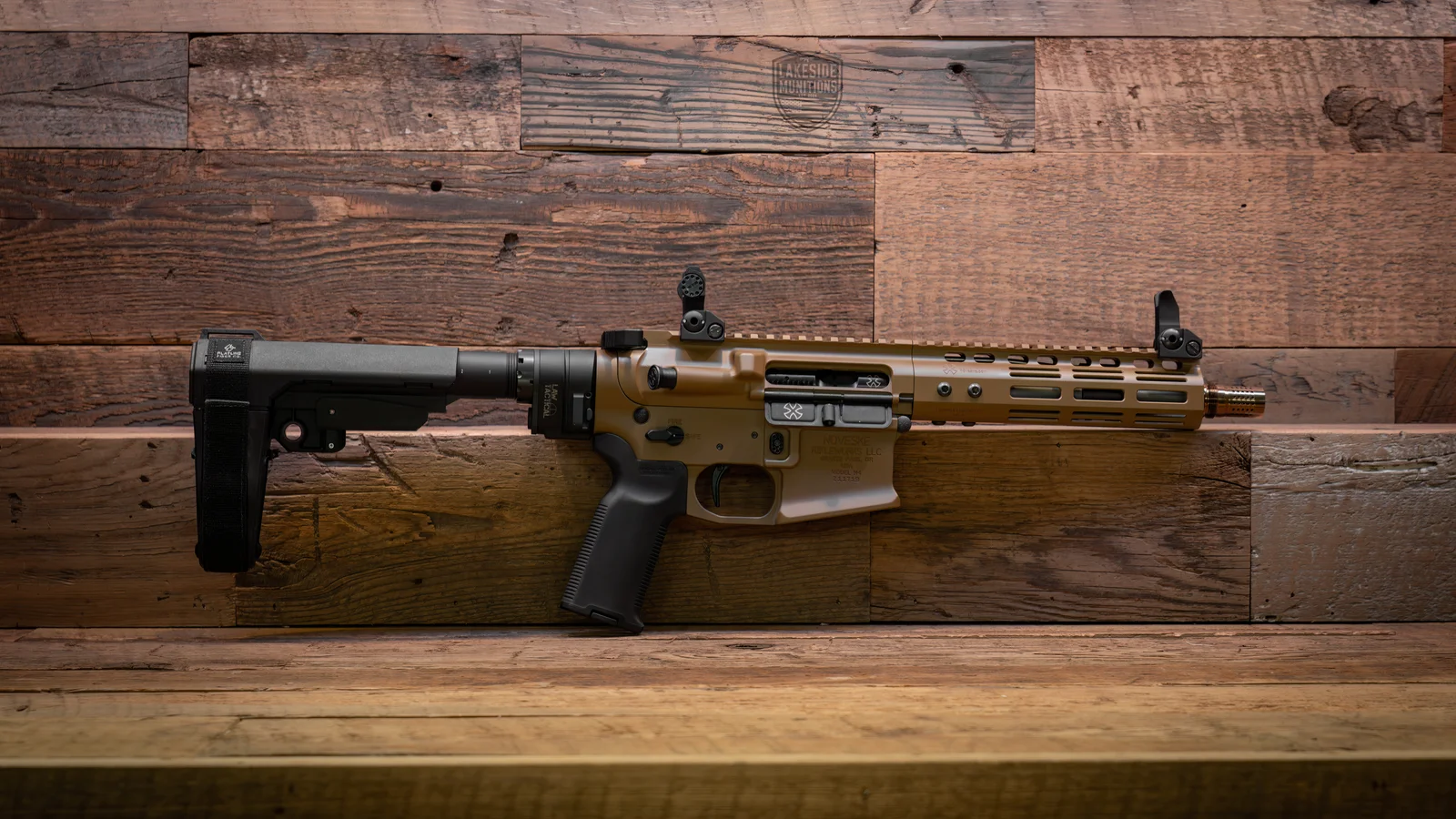
Think of the rifle as two halves. The lower holds the trigger mechanism and the hammer, and the regulation calls it the receiver. The upper is the other half, and it is a separate part. Only the lower is named in the regulation’s AR-15 example, which is why shops talk about “the lower” when they talk about the gun itself.
That also explains a common mix-up. People say they “bought an AR” when they bought a lower, and people say they “only bought a part” when they bought one. In the eyes of the law, the lower is not a part. It is the firearm. Knowing that up front saves a surprise at the counter, because the ID check and the form apply to the lower even if it is the only thing in your cart.
What to ask the counter
Before you order, a few plain questions save a second trip.
- Is the lower serialized, and will it ship to a dealer? A lower bought online needs a licensed dealer to receive it.
- What is the transfer fee? Ask for the price per firearm.
- When will you log it in, and how will you tell me it is here?
- What do I need to bring? A valid government photo ID with a current address is the starting point.
What about partly finished lowers?
Rules on partly finished and home-built receivers have been changing and have been in the courts, and they are outside what this post covers. If you are looking at a lower that is not a finished, serialized one, talk to a lawyer or ask ATF before you buy. We do not give advice on that.
Building an AR from a lower
Most people who build an AR start with a lower, then add an upper and the other parts. If you want help putting it together, our gunsmithing page lists the posted prices. Assembly of a lower or upper is $60. If you buy the part at Lakeside Munitions, we install it for free.
Two things to keep straight when you plan a build:
- The lower is bought through a dealer. Plan the ID check and the form into your timeline.
- The upper and the parts are separate choices. Ask at the counter what you can order and how it is handled.
How to check a lower before you buy
Keep it short.
- Buy from a licensed dealer, or have it ship to one. That is how the transfer is handled.
- Bring a valid government photo ID with your current address.
- Ask the counter anything you are unsure about before you pay.
The short version
The lower receiver is the legal heart of an AR-15. Federal regulation names it as the receiver, federal law counts the receiver as the firearm, and so a lower is serialized and transferred through a licensed dealer. If one is headed to our shop, see our FFL transfers page or contact us before it ships.


