

Compact vs subcompact is mostly a question of how much gun you hold in your hand. A compact pistol is a smaller version of a full-size pistol. A subcompact is smaller again. The smaller the gun, the lighter it is and the less it holds, and the more it tends to kick.
Those names sound official, but they are not. They are labels that makers and writers use, and the lines between them overlap. This post explains what the sizes usually mean, what you trade as a gun gets smaller, and how to pick a size without being fooled by a label.
Compact vs subcompact: who decides the size?
Nobody sets one rule. Federal regulations define a handgun as a firearm with a short stock that is designed to be held and fired with one hand (27 CFR 478.11). That definition covers every pistol and revolver. It does not say what counts as compact or subcompact.
So the size names come from the industry. One handgun size guide on the NRA Women website gives rough ranges, and it shows how much they overlap:
| Size | Typical barrel length | Typical weight |
|---|---|---|
| Full-size | 4.5 to 5.5 inches | 30 to 45 ounces |
| Compact | 3.5 to 4.5 inches | 20 to 30 ounces |
| Subcompact | 3 to 3.5 inches | 16 to 25 ounces |
| Micro-compact | Under 3 inches | Under 20 ounces |
Look at the edges. A 4.5 inch barrel sits in both the full-size and the compact range. A 3.5 inch barrel sits in both the compact and subcompact range. That is why one maker’s “compact” can feel like another maker’s “full-size.” Treat the label as a hint, not a measurement.
What changes as a pistol gets smaller
The same guide lays out the trade in plain terms. Smaller guns are lighter and easier to wear all day. They also usually hold fewer rounds, kick harder and can be harder to control. Bigger guns hold more, calm recoil down and are easier to shoot well, but they are heavier and bulkier.
Here is how each step usually feels:
- Full-size: The longest grip and barrel. The extra weight soaks up recoil and cuts muzzle flip, which is how far the barrel jumps up after each shot. Many full-size pistols use double-stack magazines, which are wider and can be hard to grip with small hands.
- Compact: A middle step. The guide describes it as a balance of handling ease and capacity.
- Subcompact: Shorter in the grip, often with a thinner single-stack magazine. That can fit smaller hands, but the lighter weight means more felt recoil.
- Micro-compact: The smallest. They are the smallest and lightest, and the hardest to control, and they can be tough on larger hands.
Notice the pattern. No size wins on everything. You are choosing which trade matters most to you.
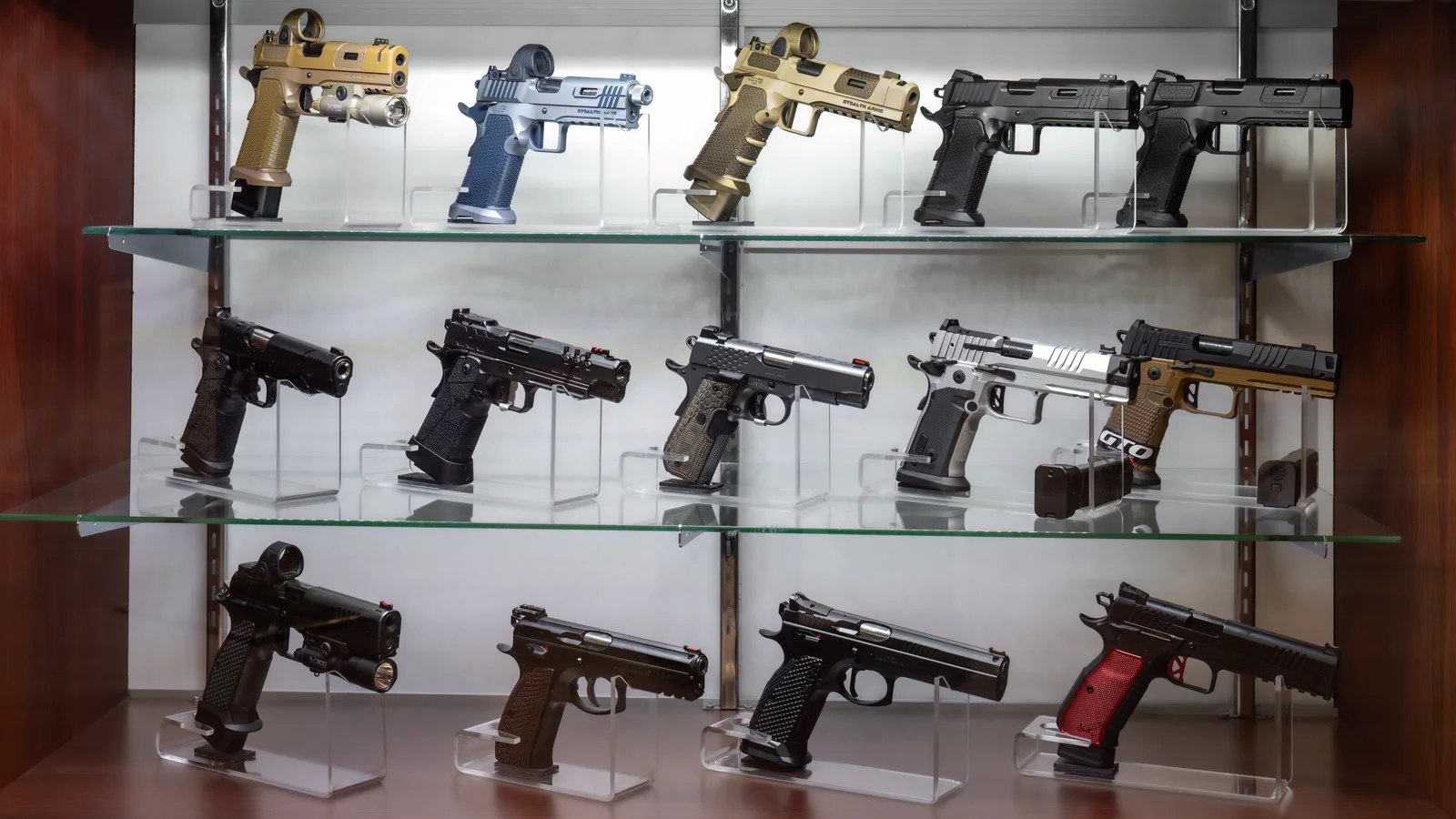
Barrel length is not the whole story
Barrel length gets the headlines, but grip length often decides how a gun fits. Your hand has to wrap the grip, and your trigger finger has to reach the trigger without twisting the gun. The NRA’s first-time handgun buyer guide says a gun should fit the hand comfortably and point naturally. It also says the controls should be easy to reach and the gun should be easy to load and unload.
Two guns with the same barrel length can feel very different in the hand. One may have a short grip that leaves your pinky hanging off the bottom. Another may have a thick grip that your fingers cannot wrap well. You cannot see that on a spec sheet.
Caliber changes size too. The same NRA guide notes that a 9 mm pistol can be made smaller and lighter than a pistol for a larger cartridge like the .45 ACP. So a size label also depends on what the gun fires.
What size should a first-time buyer look at?
There is no single right answer, and anyone who gives you one without seeing your hands is guessing. A few honest rules of thumb:
- Start in the middle. A compact is a common place to begin because it sits between the extremes. A very small gun is harder for a new shooter to control, and a very large one can be tiring to hold.
- Match the size to the job. A gun for the range or the nightstand can be bigger. A gun you want to wear on your belt wants to be smaller and lighter.
- Do not chase the smallest gun. The size guide says a lighter gun means more recoil, and the NRA buyer guide says beginners usually shoot faster and more accurately with lower-recoil cartridges. Small does not mean easy.
- Think about your hands. Larger hands can struggle on tiny grips. Smaller hands can struggle with wide double-stack grips.
Whatever you pick, learn the basics first. The NSSF’s rules of firearms safety start with keeping the muzzle pointed in a safe direction and being sure of your target and what is beyond it. Those rules do not change with the size of the gun.
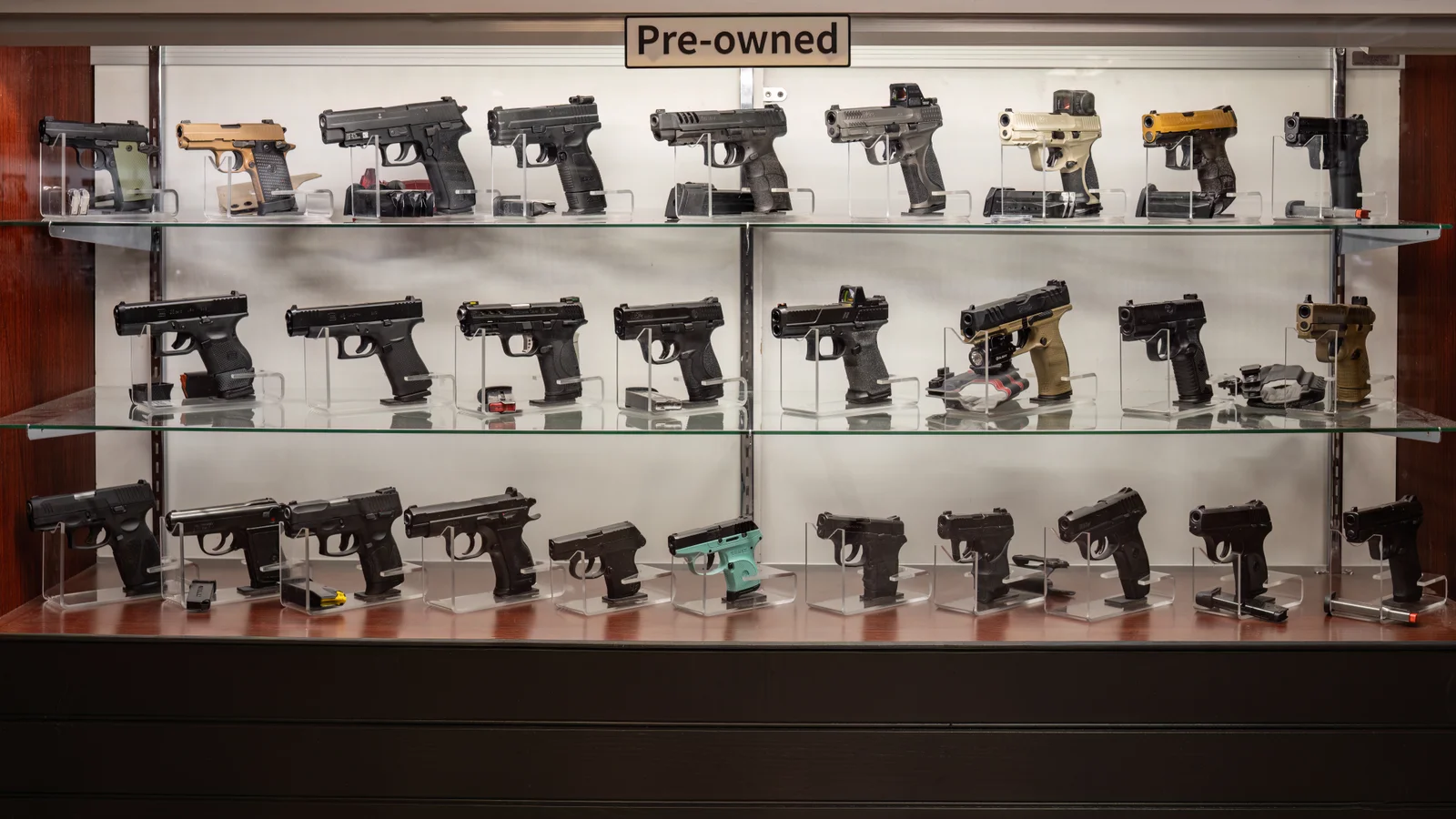
How to try sizes before you buy
A label cannot tell you how a gun fits. Your hands can. The NRA guide suggests test-firing a specific model before you buy, because guns of the same type can differ widely in how they operate, feel and shoot. Its list of ways to do that includes a safety course, a friend who owns guns, or a gun counter with in-house ranges.
You can start with a lot less than a range trip. Ask to handle a few sizes at a counter, with the gun unloaded and the muzzle pointed in a safe direction. Then check these things:
- Can you wrap your hand around the grip so the gun sits in line with your forearm?
- Can your trigger finger reach the trigger without shifting your grip?
- Can you reach the magazine release and the slide controls without a big hand change?
- Does the weight feel like something you would carry and hold, or something you would leave at home?
Do this with two or three sizes in a row. The differences show up fast when you handle them back to back.
Not seeing the size you want?
Sizes matter, but so does having the right one in front of you. We will not name one gun as the pick for a first-time buyer. Handling is the point. Come by the counter at Lakeside Munitions, ask to hold a few sizes, and tell us what you want the gun for. We would rather you walk out knowing what fits than walk out with the wrong size.
If you find the gun you want somewhere else, or want one that is not on our shelf, we can help with that too. Read how a special order works, or how an FFL transfer lets you bring a gun you bought online through our counter. If you are new to all of this, our post on buying your first gun in Georgia walks through what happens at the counter. When you are ready, send us a note or come by and say hello.

