

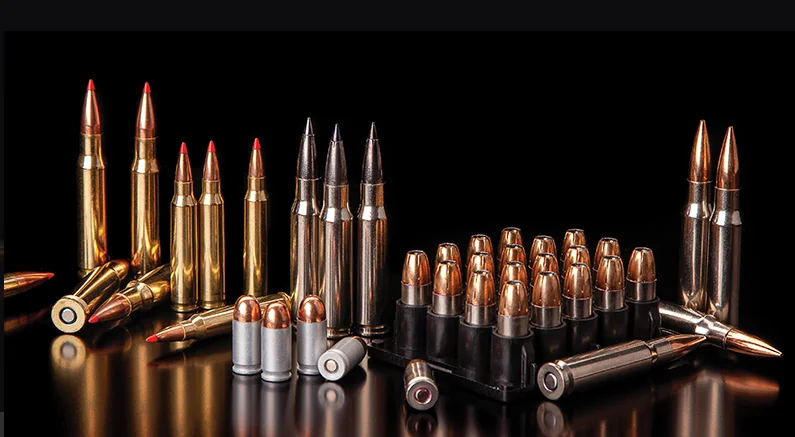
The FMJ vs hollow point difference comes down to the bullet’s shape. FMJ means full metal jacket. It is a bullet with a lead core covered in a metal jacket, built to hold its shape. A hollow point has a hollow tip and is built to open up, or expand, when it hits something. FMJ is the common choice for practice. Hollow points are the common choice for self-defense and hunting.
Both fit the same gun. The difference is in how the bullet behaves after it leaves the barrel.
What FMJ ammo is
On the box, FMJ stands for full metal jacket. The jacket is a thin shell of metal around a softer core. The nose is closed and rounded.
Hornady describes the jacket on its FMJ bullets as one designed to hold its shape on impact, and to punch through targets without deforming or breaking (Hornady FMJ bullets). That is the idea behind FMJ: a bullet that stays together.
FMJ is also what you see in many practice loads. Federal’s American Eagle 9mm 115 grain full metal jacket load, for example, is listed at 1,180 feet per second from a 4 inch test barrel (Federal AE9DP). If you are new to bullet weights, our post on what grain means in ammo explains the 115 on that box.
What a hollow point is
A hollow point has a small cavity in the nose. When it hits something soft, the cavity helps the bullet open up and spread. That wider bullet is the point. You will also see it written JHP, for jacketed hollow point.
Hornady says its XTP hollow point is built for hunting, self-defense and law enforcement work. Its jacket changes in thickness along its length, which Hornady says is what controls the expansion. Hornady also says the nose is protected by the jacket, which helps the bullet feed in a semi-auto pistol (Hornady XTP).
Not every hollow point opens the same way. Each maker builds its own design, and results vary with speed, gun and what the bullet hits. A hollow point is built to expand, but we cannot promise that any one load will.
Jackets, plating and why it matters
Not every bullet with a metal coating is a true jacketed bullet. Hornady contrasts its jacketed bullets with plated bullets that have thin walls of uniform thickness. It says thin plating is easily distorted and often breaks or separates on impact, while its FMJ jacket is built to stay together (Hornady FMJ bullets). It also says its XTP jacket varies in thickness along its length, which it credits for controlled expansion (Hornady XTP).
That is Hornady describing its own products, so read it as one maker’s view. The takeaway for you is simple. Read the box. It will say whether a bullet is plated, jacketed, FMJ or hollow point.
FMJ vs hollow point: how the two compare
| FMJ | Hollow point (JHP) | |
|---|---|---|
| Tip | Closed, rounded | Hollow cavity in the nose |
| Built to | Hold its shape | Expand on impact |
| Common use | Practice and range | Self-defense, hunting |
| Maker’s wording | Hornady: holds shape, punches through | Hornady: controlled expansion |
Use this as a rough guide. It is not a rule. Some makers sell hollow points for practice too, and some FMJ loads are sold for other jobs.
Why people practice with FMJ and defend with hollow points
Federal sells its 9mm in lines with names that point to the job, such as training and range lines on one side and personal defense lines on the other (Federal 9mm Luger). That shows how the industry groups them.
The idea is simple. You shoot more rounds at the range than you ever would for defense, so many shooters pick a practice load for that. For defense, they want a bullet made to perform in a target, which is where hollow points come in.
If you practice with one load and keep another for defense, the gun may not act the same with both. Many shooters fire a few boxes of the exact defense load they choose to see that it feeds and runs in their gun. That is advice, not a legal or safety rule. Ask the counter if you want help picking a load to test.
How ammo is tested
Agencies do not just trust the label. The FBI’s ammunition test protocol, as published by Hornady, fires into 10 percent ordnance gelatin, a material used to stand in for soft tissue. It runs six tests: bare gelatin, heavy clothing, steel, wallboard, plywood and automobile glass (Hornady, FBI test protocol).
The point of the barriers is that bullets behave differently after they pass through something first. A bullet that works well in bare gelatin may act differently after plywood or glass. This is why makers publish test results for their defense loads, and why one hollow point is not the same as the next.
We are not telling you which load passes. That depends on the exact load and the test, and the full numbers belong to the makers and the agencies.
Does a hollow point fit every gun
Mostly, yes, but check. A hollow point has a different nose shape than an FMJ. Hornady says its XTP nose design helps with feeding in semi-autos, which tells us feeding is something makers design for. That is the maker’s claim for its own bullet, so test yours.
The best answer is to test it. Run a few magazines of the load you want, and make sure it feeds, fires and ejects every time. If it does not, try a different load or ask the gun’s maker.
Reading the letters on the box
Boxes use short codes. Here are the ones in this post:
- FMJ: full metal jacket, the closed, rounded nose.
- JHP: jacketed hollow point.
- Grain (gr): the bullet’s weight. See our post on what grain means.
- +P: loaded to a higher pressure than standard. SAAMI, the trade group that sets voluntary ammunition standards, lists 9mm Luger at 35,000 psi and 9mm Luger +P at 38,500 psi (SAAMI Z299.3). Check your gun’s manual before you shoot +P.
Where you can shoot each type
Some ranges set rules on what ammunition you can use. We do not run a range, so we cannot tell you any range’s rules. Call the range before you go and ask what it allows. That is a quick call that can save you a trip.
For hunting, the rules come from the state and the land you hunt on. We do not cover them here.
What to buy first
If you have a new gun, start with FMJ for practice. It is the load you will shoot the most. Learn the gun. Then, if you want a defensive load, pick a hollow point in the same caliber and test it in your gun.
Match caliber first, always. If you are deciding between two calibers, read our 9mm vs .380 post.
Ask at the counter
Bring your gun’s caliber and what you plan to do with the ammo, and ask. We can talk through the choices at the counter in Cumming. Contact us before you drive over if you want to ask about a particular load, or start from our home page for hours and directions.
Sources checked November 2026. Speeds are Federal’s listed numbers from a 4 inch test barrel. Maker claims come from the makers’ own pages.

